

Just the thought of worms makes any pet owner cringe and lose their appetite. Intestinal worms are common in dogs and cats. They become infested with these parasites by ingesting contaminated food, faeces, grass and from infected rodents. They can also be transmitted in the mother’s womb, through mother’s milk or fleas.
There are 4 common types of intestinal worms that can be found in the pet’s digestive system – roundworms, hookworms, whipworms and tapeworms.
Roundworms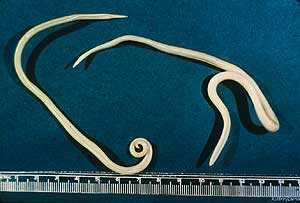
Roundworms are one of the most common parasites found in the digestive system of dogs and cats.
Puppies and kittens can contract roundworm larvae while in the mother’s womb or through mother’s milk. Adult dogs and cats can contract roundworm by coming into contact with or consuming contaminated soil, vomit or faeces.
Adult roundworms can grow up to 13cm long, are spaghetti-like, cream coloured, live in the host’s intestines and feed off of the food ingested by the host – robbing the host of essential nutrients. An adult female roundworm can produce 200 000 eggs in one day. These eggs are passed in the infected pet’s faeces. Protected by a hard shell, roundworm eggs can exist in soil for years.
Roundworm infestations are usually relatively benign, but affected puppies and kittens can experience symptoms such as a pot-bellied appearance, abdominal discomfort, loss of appetite, vomiting and diarrhoea. If left untreated, in time a severe roundworm infestation can lead to intestinal blockage, which can be fatal.
Hookworms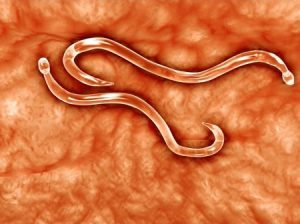
Hookworms are very small, thin worms that literally hook into the wall of the small intestine and feed off the host’s blood. A female hookworm produces hundreds of eggs which are passed in the infected pet’s faeces. The eggs can survive for a long time in the environment. Hookworm eggs are not visible to the naked eye.
Dogs and cats can become infected with hookworm when they eat, walk through or roll around in infected faeces or contaminated soil. When ingested, hookworm larvae have a direct path to the intestinal wall. They can also burrow into the skin, making their way to the intestines.
Puppies and kittens can become infected with hookworm through the mother’s milk.
Severe hookworm infection can kill puppies and kittens, causing them to become severely anaemic from blood loss due to the hookworms’ vampire-like activities. Symptoms of a severe hookworm infection includes bloody diarrhoea or black stool, weight loss, anaemia and progressive weakness.
Whipworms
Whipworms are long and thread-like with a small club-like end. They lie coiled in the mucosal lining of the large intestine and feed on the tissue of the intestinal wall. Whipworms can grow to about 2 to 5 cm long.
Adult whipworms lay eggs in the intestines that are then passed in the infected pet’s faeces. The eggs are very hard and can tolerate practically all environmental conditions – from months to years.
Pets can become infected with whipworm when they ingest soil, food or water that has been contaminated with whipworm eggs. They can also ingest these eggs when they groom themselves after rolling in contaminated soil. Once ingested, the eggs mature in the small intestine into larvae. The larvae then travel to the large intestine, where they become whipworms and “worm” their way into the mucosal lining of the intestine.
Pets with a heavy whipworm infection may suffer from bloody diarrhoea, anaemia, dehydration and weight loss.
Tapeworms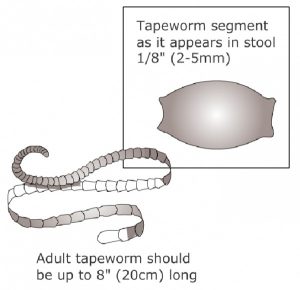
Tapeworms have long, flattened, segmented bodies with a small head. The segments are filled with eggs. Tapeworms can grow between 10 and 20cm long and may have as many as 90 segments.
Adult tapeworms live in the small intestine with its head attached to the intestinal wall. They feed off nutrients consumed by the host. As segments farthest from the head become mature, they break off and are passed in the host’s faeces.
The segments look like a white grain of rice when fresh and a sesame seed when dry. These segments can be seen with the naked eye – in the faeces and/or around the anal area.
Fleas and lice act as intermediate hosts and carriers of tapeworm.
Pets become infected with tapeworm when they ingest infected rodents or by ingesting infected fleas while grooming. Tapeworms can cause your pet to scoot its rear end along the floor, although this is not always the case.
Treatment
Deworming your pet 3 to 4 times a year with a broad spectrum deworming tablet prescribed by your vet will help to keep these nasty parasites under control.
If your pet is suffering from a heavy intestinal worm infestation, your vet will prescribe a specific deworming schedule.
Deworming medication like, Milbemax (tablets by Elanco for dogs & cats), Triworm (tablets by Ascendis Animal Health for dogs & cats), Milpro (tablets by Virbac for dogs & cats), Drontal (tablets by Bayer for dogs & cats) and Profender (a spot-on by Bayer for cats) can be purchased from your local animal clinic or vetshop.
Deworming is dosed according to weight. Thus it is important that you keep track of your pet’s weight to prevent under dosing.
There are also a few tick and flea treatments that contain a dewormer – namely Broadline by Boehringer Ingelheim (effective against tapeworm, hookworm, whipworm, roundworm, heartworm and lungworm), Bravecto Plus for cats by MSD Animal Health (effective against roundworm, hookworm and heartworm) and Nexgard Spectra by Boehringer Ingelheim (effective against roundworm, hookworm, whipworm and heartworm).
It is also very important to deworm family members at least twice a year – speak to your doctor or pharmacist.
