
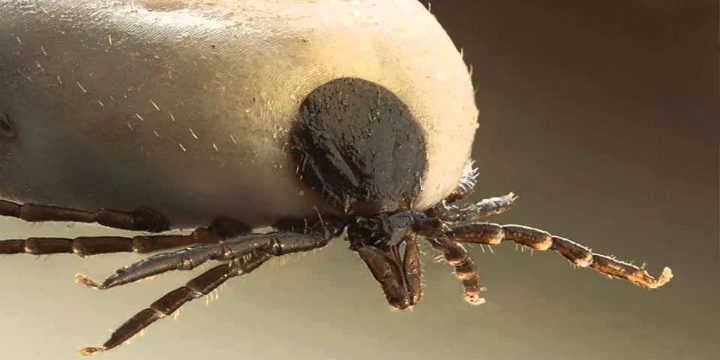
Ticks are found worldwide. They are wingless, eight-legged external parasites that feed on the blood of their hosts. Of all the external parasites, ticks are among the most dangerous, because they can transmit several types of disease agents.
There are several types of ticks found in South Africa – divided into two 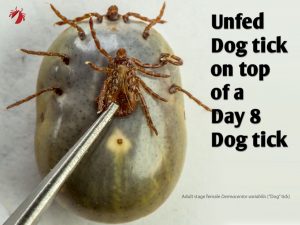 important groups, namely hard ticks (Ixodidae) and soft ticks (Argasidae).
Dogs are more affected by ticks than cats, because dogs are more likely to go into tick territory. Cats are more likely to get rid of a tick(s) by themselves, because of their intensive self-grooming behaviour.
The life cycle of the tick
Eggs – Tick eggs are laid by the female tick on the ground. Hard tick females lay a small batch of thousands of eggs in a sheltered spot and then they die. Soft tick females will lay repeated batches of eggs (about 500 eggs per cycle), on the ground, in between feedings.
Larvae – After a period of weeks or even months, tiny six-legged larvae hatch from the eggs. The larvae of some species of ticks climb onto stems of grass or other plants and wait for a host to pass by to climb onto, while the larvae of other species molt into the next stage. Hard tick larvae feed for several days, while soft tick larvae feed within 15 – 30 minutes.
Nymphs – The larvae molt into eight-legged nymphs. The nymphs of hard ticks require a few days for their integument to harden before climbing on and attaching to a host and feeding for several days. Once engorged, they drop to the ground and molt into the next stage. Soft tick nymphs repeat the cycle of host seeking, feeding and molting up to seven times before finally molting into the next stage.
Adults – After molting into adults the hard tick requires a few days for the integument to harden before finding and attaching to a host. The female will feed for about 24 hours before mating. After mating the female engorges, detaches, drops to the ground and lays eggs. The male may remain on the host for months before finally dying. Soft tick adults do not require a blood meal before mating. Mating occurs before and after feeding, but rarely, if ever on the host itself.
Mouthparts of the tick
The mouthparts of the tick are quite complex and are designed to prevent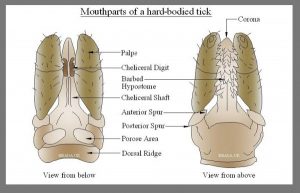 easy removal from the host’s skin.
They are designed to penetrate the skin. The chelicerae consists of movable rods with sharp claws at the ends. It is these chelicerae that frill into the skin and, together with the hypostome, form a tube through which the blood is ingested.
A cement-like substance in the tick’s saliva “glues” the palps to the surrounding skin and the chelicerae to the inside of the wound. This prevents the tick from falling off.
Diseases associated with tick bites
Tick bites are generally painless and animals usually do not feel them. Some redness and irritation can develop around the area of the bite, but in some cases a tick bite can develop into an abscess and become very painful.
Ticks can transmit tick-born diseases which can be fatal:
- Babesiosis (Bilary fever)
- Canine Ehrlichiosis (Tick bite fever)
- Ehrlichia and Rickettsia of dogs
Symptoms include, but are not limited to:
- pale gums/inner eyelids
- weakness/lethargy
- loss of appetite
- increased heart rate
- panting/laboured breathing
- anemia in very young puppies and kittens
Finding ticks on pets
Ticks will crawl around for up to several hours in the host’s fur until they 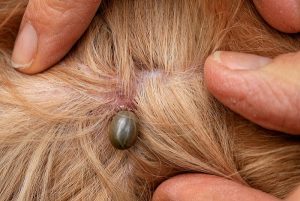 find an adequate place to bite. This means that when a pet picks up ticks during a walk outdoors, some ticks may still be crawling around while other ticks may have already attached, by the time he returns home.
To inspect a pet for already attached ticks you have to open the fur and patiently look for ticks and/or thoroughly feel through the fur for any lumps. Do not forget to check the face, around the eyes, the ears, between the toes and under the tail. It is most likely that you will only find ticks that have already started feeding.
Removing a tick
It is recommended that you grasp the tick directly, using a fine-tipped tweezer, close to the skin. Then pull firmly, but gently and straight up until all the parts of the tick is removed. Be careful not to squeeze the tick’s body.
Do not twist or jerk the tick as this may cause the tick’s mouthparts to break off and remain in the skin, which may cause infection.
After removing the tick, clean the bite wound with disinfectant and wash your hands thoroughly with soap and water.
There are a few tick-removing-tools available on the market.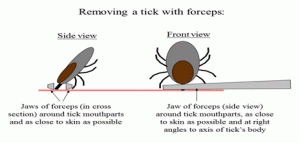
If you do not feel comfortable removing the ticks yourself, rather have your vet or vet nurse remove them for you.
Tick prevention and control
There is a wide variety of products available on the market these days for the treatment of ticks on cats and dogs.
Tick powder – Generally, tick powders are only effective for as long as they remain on the pet’s fur and are not a good choice for treatment.
Tick shampoo – Contain insecticides which kill ticks, but they are only effective while the product is on the pet and should therefore be used in conjunction with a tick collar, tablet or spot-on.
Tick collars – Most tick collars are made of plastic, or thick textile or polymer impregnated with an insecticide that is released to the pet’s fur/skin and spreads to the rest of the body. E.g. Seresto collar for cats and dogs.
Spot-on tick treatments – There are several effective spot-on products, with different active ingredients, available on the market. These products are a liquid that are applied as drops at the back of the pet’s neck between the shoulder blades and must be applied monthly. The product is spread over the pet’s body by the natural oils of the skin. E.g. Advantix (dogs only), Frontline Plus, Ex-Spot(dogs only), Revolution.
Oral/Tablet form tick treatments – These products all contain different active ingredients that work systemically. They are absorbed into the blood stream and distributed through the pet’s body. The products are not influenced by bathing, swimming, exposure to sunlight or dirt. The residual effect of each product differs. E.g. Bravecto (dogs only) that lasts up to 3 months and Nexgard (dogs only) that lasts 4 weeks.
Sprays – Spray-on tick treatment must be sprayed over the pet’s body in such a way that it reaches the pet’s skin. This might be a challenge with pets that have long and/or thick fur. The “hiss” sound that it makes when the liquid id sprayed out of the nozzle might frighten cats and some dogs. E.g. Frontline spray, Ultrum Ultimate spray, Fiprotec spray
Please be very careful when using flea treatments on cats, as some of the products are for use on dogs only and can contain ingredients that are toxic to cats. Always make sure the product is registered for use on cats.
We will never be able to eradicate ticks; the only thing you can do is to try and control them in our pets’ environment and apply tick treatments regularly, as directed, throughout the year.
