

Teeth are a vital part of your pet’s anatomy. They are highly specialised structures that tear, cut and grind food into pieces small enough to swallow. Teeth also serve as weapons of offense and defense.
Location of the teeth
The teeth are anchored in the upper jaw bone (maxilla) and the lower jaw bone (mandible) of your pet’s mouth. The shape of your pet’s skull affects the positioning of the teeth.
Each tooth sits in a socket in the jaw bone, called an alveolar socket, and held firmly in place by ligaments, a bone-like substance called cementum, soft tissue and bone.
General function of the teeth
Just like humans, our pets use their teeth to tear and process their food. They cut and grind the food into smaller pieces. Each type of tooth serves a different function in the chewing process.
Stages of dental development
Just like humans, cats and dogs have two sets of teeth, deciduous (baby) teeth and permanent (adult) teeth.
In puppies and kittens, the deciduous teeth begin to erupt through the gums at about 3 – 4 weeks of age. From 3 months of age the deciduous teeth start falling out, making way for the permanent teeth. By about 6 – 8 months of age, usually all the permanent teeth have emerged.
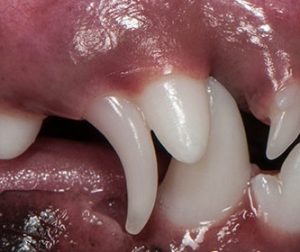
Image: Google Images
Dogs have 28 deciduous teeth (14 upper and 14 lower) and 42 permanent teeth (20 upper and 22 lower), whereas cats have 26 deciduous teeth (14 upper and 12 lower) and 30 permanent teeth (16 upper and 14 lower).
From time to time, a permanent tooth will emerge before the deciduous tooth has fallen out (referred to as retained deciduous tooth). The retained tooth will need to be removed surgically to prevent abnormal alignment of the permanent tooth.
Types of teeth
Each tooth in your pet’s mouth plays an important tole. They are categorised into four types, namely incisors, canines, premolars and molars.
Incisors – These are the small teeth in the front of the mouth. Their main function includes tearing, chewing or nibbling on food, picking up objects, pulling something or even for scratching purposes (when your pet has an itch). Cats and dogs each have 12 incisors (6 upper and 6 lower).
Canines – These are long and pointed teeth located on either side of the incisors. The upper canines lock behind the lower ones (called a scissor bite). Their main function are to grab and tear. Cats and dogs both have 4 canines (2 upper and 2 lower).
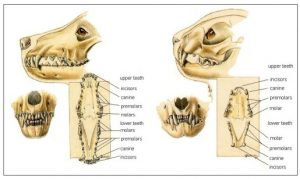
Image: Google Images
Pre-molars – These are the wide, flat, pointed teeth behind the canines. Their main function are to chew and grind food into small enough pieces to swallow. Dogs have 16 pre-molars (8 upper and 8 lower) and cats have only 10 pre-molars (6 upper and 4 lower).
Molars – The molars are located behind the pre-molars. They are bigger and a bit sharper than the pre-molars. Their main function are to chew and cut food into small enough pieces to swallow. Dogs have 10 molars (4 upper and 6 lower) and cats have 4 molars (2 upper and 2 lower).
Anatomy of the tooth
Dogs and cats have teeth that are very similar to human teeth. Each tooth has a crown and a root and is composed of four types of tissue, namely pulp, dentin, enamel and cementum. The tissue surrounding each tooth is called peridontum and consists of alveolar bone, periodontal membrane and the gums (gingiva).
Crown – The crown is the visible part of the tooth above the gums. This is also where the plaque and tartar accumulate, causing a yellow or brown discolouration of the tooth and sometimes bad breath.
Neck – This is the part of the tooth right at the gumline. The tooth has a slight narrowing here.
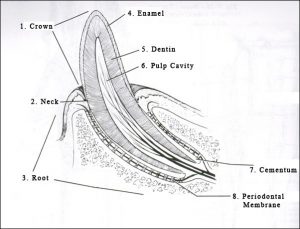
Image: Google Images
Root – Is the part of the tooth below the gums and is embedded in the alveolar bone. Some teeth, like the incisors, have only one root, while others, like the pre-molars, have as many as three roots.
Pulp cavity – Is the centre (core) of the tooth. It consists of connective tissue, blood vessels and nerves. The blood vessels nourish the tooth and the nerves transmit sensations of pain, coldness or heat to the brain.
Dentin – Is a hard yellow substance that surrounds the pulp and makes up most of the tooth and gives the tooth an ivory or creamy colour. Dentin is as hard as bone and mainly consists of mineral salts and water.
Enamel – Is the hard outer covering of the tooth. Enamel is stronger than bone and enables the tooth to withstand the pressure placed on it during chewing. Although enamel is very hard, it is brittle too, often subject to chipping.
Cementum – Is hard, calcified tissue that covers the dentin along the root and helps to “cement” the tooth into the jawbone. In most cases, the cementum and enamel meet where the root ends and the crown begins.
Periodontal ligament or membrane – Is the tough tissue that helps to hold the tooth in the socket. It attaches to the cementum of the tooth and the alveolar bone.
Sources/Additional reading:
icatcare.org – Feline dentition – Cat’s teeth
princetonvet.net – Your dog’s teeth
