
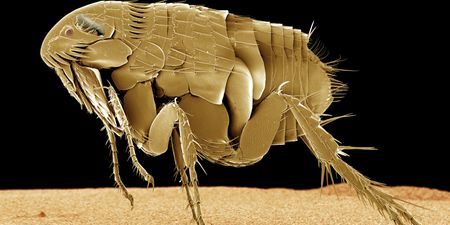
Fleas have been around for centuries and will, unfortunately, always be part of nature and our environment. They are the most common external parasite to plague cats and dogs and they are an ongoing frustration for pet owners everywhere.
The most common flea to infest cats and dogs, worldwide, is the Ctenocephalides felis, better known as the “cat flea”.
Life cycle of the flea
Eggs – Flea eggs are whitish in colour, oval in shape and about 0.5mm long. They are laid in the pet’s fur, but easily fall to the ground where they lie in cracks, carpets, pet bedding or under furniture awaiting the right conditions to hatch. The eggs hatch in about 1 – 10 days, depending on the temperature and humidity.
Larvae – Flea larvae hatch from the eggs with a small, thin, white, hard-covered, segmented body, measuring 1 – 2mm in length. They feed on flea faeces (“flea dirt”), flea egg shells, organic debris and other flea larvae which makes them become darker in colour. The larvae moult twice before developing into pupae 7 – 10 days after emerging from their eggs, depending on the temperature and humidity.
Pupae – Flea pupae are whitish in colour, sticky, silk cocoons, about 0.5cm long. There pupae can be found in vegetation, carpets, furniture, in soil, etc. The mature flea larvae spins a loose, protective cocoon and develops into a pupae. The sticky surface of the cocoon quickly become coated with debris from the environment, which helps to camouflage it. This cocoon is also very resistant to dryness and most insecticides. The adult flea develops inside the cocoon within 5 – 10 days and can stay dormant for about 350 days awaiting the right conditions.
Adult – Adult fleas are reddish brown in colour, 6 legged, wingless, have a  laterally flattened body with a smooth exoskeleton and are about 2 – 5mm long. Under normal conditions an adult flea can generally live 2 – 3 months. After emerging from the cocoon they wait for a host to come near enough, then jump on and move around in the fur searching for a suitable place to suck blood. Fleas can jump about 20cm vertically and 35cm horisontally, yet they do not readily move from one host to another. This means that the fleas that re-infect your pet come mostly from the environment and not another pet. Fleas start to mate 8 – 24 hours after the first blood meal and female fleas start to lay eggs 24 – 48 hours later. A female flea can lay about 40 – 50 eggs a day.
Identifying a flea infestation
 On pets with light fur that is not too thick it may be possible to see the adult flea moving through the fur. Flea faeces, or “flea dirt”, may also be noted in the pet’s fur.
You can also use a flea comb to comb through your pet’s fur to check for fleas or “flea dirt”.
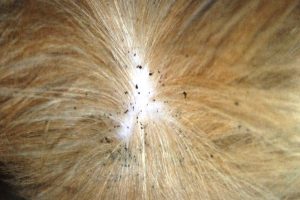 When your pet scratches, licks and bites excessively at its skin, is could be a sign of fleas.
Treating a flea infestation
There is a wide variety of products available on the market these days for the treatment of fleas on pets and in the home.
Aerosol and foggers – In the home you can use an aerosol like Ultrum Duration spray. There is also a range of commercial sprays and foggers available from the supermarket and Co-op.
Flea powder – Generally, flea powders are only effective for as long as they remain on the pet’s fur and are not a good choice for treatment.
Flea shampoo – Contain insecticides which kill adult fleas, but is only effective while the product is on the pet and should therefore be used in conjunction with a flea collar, tablet or spot-on.
Flea collars – Most flea collars are made of a plastic, thick textile or polymer impregnated with an insecticide that is released to the pet’s fur and spreads to the rest of the body. Some flea collars contain an insect growth regulator to kill the eggs and larvae as well. E.g. Seresto collar for cats and dogs.
Spot-on flea treatments – There are several effective spot-on products, with different active ingredients, available on the market. These products are a liquid that is applied as drops at the back of the pet’s neck and must be applied monthly. The product is spread over the pet’s body by the natural oils of the skin. E.g. Activyl, Advantage, Frontline, Revolution, Ex-Spot, etc.
Oral/tablet form flea treatments – These products all contain different active ingredients that work systemically. They are absorbed into the blood stream and distributed through the pet’s body. These products are not influenced by bathing, swimming, exposure to sunlight or dirt. The residual effect of each product differs, e.g. Capstar which lasts only 24 hours. Other examples are Bravecto and Nexgard (dogs only) and Comfortis.
Sprays – Spray-on flea treatment must be sprayed over the pet’s body in such a way that it reaches the pet’s skin. This might be a challenge with pets that have long and/or thick fur. The “hiss” sound that it makes when the liquid is sprayed out of the nozzle might frighten cats and some dogs. E.g. Frontline spray, Ultrum Ultimate spray and Fiprotec spray.
Please be very careful when using flea treatments on cats, as some of the products are for use on dogs only and can contain ingredients that are toxic to cats. Always make sure the product is registered for use on cats.
